Dies · mould · tooling
Pultrusion dies, designed with you and proven on a running line.
Every die starts with a design-for-manufacture review of your cross-section and ends with a trial pull on the factory's own line. Tube, rod, structural, deck and grating dies are cut in the factory's die shop: three gantry machining centers, ten high-speed CNC mills, EDM and wire-cut.
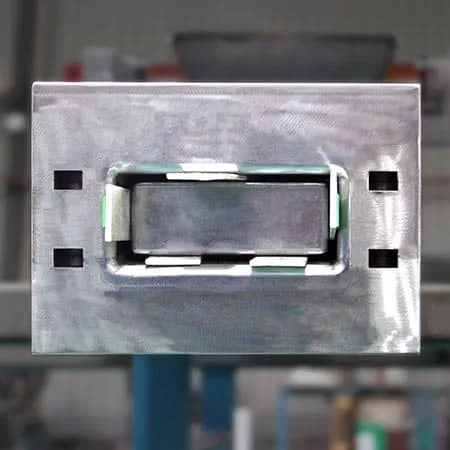
Tube and rod pultrusion dies
Dies and mandrels for hollow tubes from φ20 mm to φ186 mm and solid rods in single and multi-cavity layouts.
Profiles and specs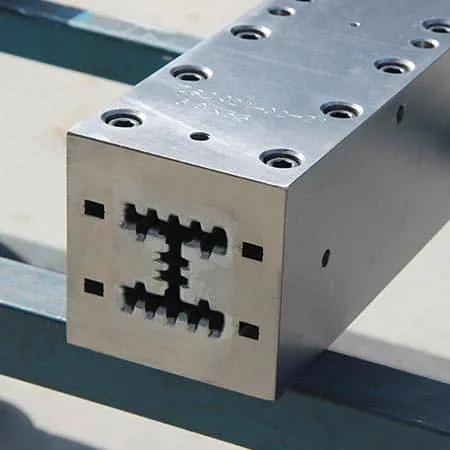
Structural profile pultrusion dies
Open-section and multi-web dies for structural shapes, walkway and grating components, deck boards and flat strip.
Profiles and specs
Custom pultrusion die
Dies for sections outside the standard families: window and door frames, shutters, ladder rails, radome profiles and dies for third-party machines.
Profiles and specs
From drawing to die
Five steps, each with something you approve or receive.
Steel is cut only after you approve the 3D model. The die ships only after a trial pull and dimensional report.
- 01
Cross-section review
Buyer + die engineer
You send the drawing, resin system and target speed. The team checks wall thickness, radii and corners for pultrudability.
- 02
DFM feedback
Die engineer
Written feedback on changes that improve cure, fiber placement and die life, with the proposed fiber layout.
- 03
3D model approval
Buyer approval
Die plates, mandrel, heating layout and guide plates are modeled. Steel is cut only after you approve.
- 04
Machining and chrome
Die shop
Gantry milling, CNC, EDM and wire-cut, heat treatment, polishing and hard chrome plating.
- 05
Trial pull and report
Factory QC
The die runs on the factory's own line. You receive samples and a dimensional report before shipment.
The die shop
Where the dies are made

Design CNC machining 
Grinding 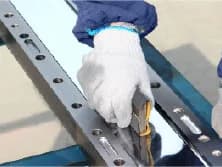
Polishing 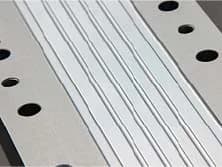
Chrome plating 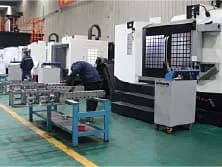
Trial pull
FAQ
Pultrusion die basics
- What is a pultrusion die?
- A pultrusion die is a heated, chrome-plated steel cavity through which resin-impregnated fiber is pulled. The resin gels and cures inside the die, so the die sets the profile's dimensions, surface and much of its quality.
- Is a pultrusion die the same as a fiberglass mold?
- No. A hand-layup or RTM mold forms one part at a time. A pultrusion die is a continuous-process tool that runs under heat and pull force for thousands of meters. This page covers pultrusion dies only.
- Can you build dies for a machine you did not supply?
- Yes. Send the die table size, heating-plate layout and clamping method of your machine with the profile drawing.
- How long does a die last?
- Die life depends on steel, chrome thickness, filler content and line speed. Wear starts at the die entry; re-chroming before the steel itself wears extends life. The factory states an expected life per die rather than a generic figure.
Next step
Send a cross-section drawing for a free DFM review.
Quotations state the manufacturer, the exporter of record, the warranty party, FAT scope and payment milestones. No figure is quoted without a drawing.