Pultrusion die
Tube and rod pultrusion dies
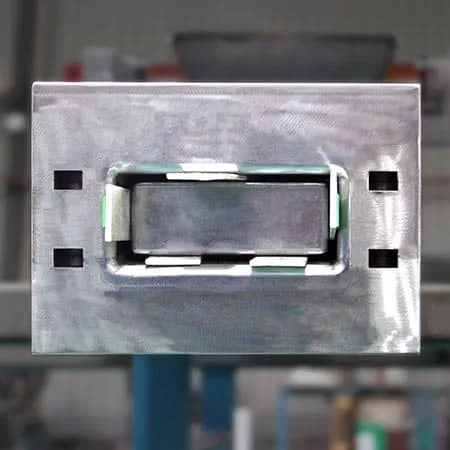
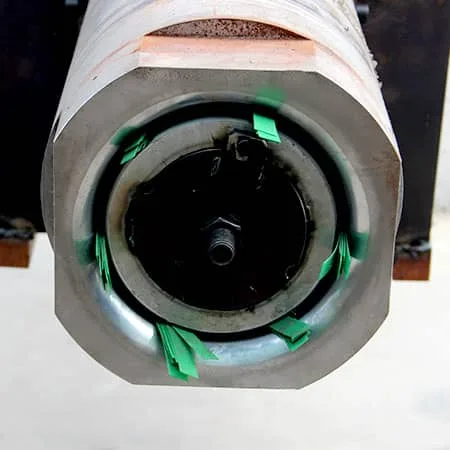
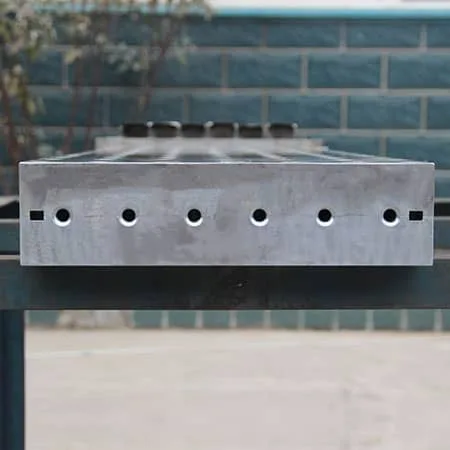
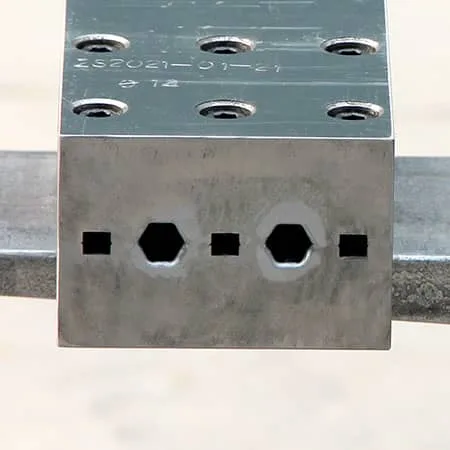
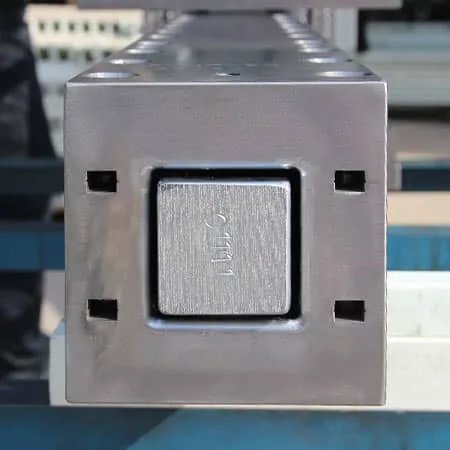
A tube pultrusion die is a heated steel cavity with a cantilevered mandrel that forms the bore while the resin cures. Rod dies have no mandrel and are often built with several cavities so one machine pulls several rods at once. The factory has built tube dies from φ20 × 2 mm to φ186 × 6 mm and six-cavity rod dies.
Specification
Configuration table
Every cell is either a figure supplied by the factory or TBD · ask factory. No typical values. Source: frpzs.com pultrusion die (mould) catalogue pages, fetched 2026-10-19; values are catalogue statements confirmed per die on the drawing.
| Parameter | Value |
|---|---|
| Die steel options | 40Cr, P20, Cr12MoV, 38CrMoAl or H13 (by application) |
| Base hardness | HRC 55–60 (catalogue) |
| Cavity surface treatment | Quench and temper, nitriding or induction hardening, hard chrome plating |
| Hard chrome thickness | 0.04–0.05 mm (catalogue) |
| Straightness | ≤ 0.02 mm over 1,000 mm (catalogue) |
| Profile dimensional tolerance | ±0.1 to ±0.3 mm depending on section (catalogue) |
| Resin systems | UP polyester, vinyl ester, epoxy, phenolic, polyurethane |
| Service life before re-chrome (m) | TBD · ask factory |
| Lead time (working days) | TBD · ask factory |
Scope of supply
What is included, what is quoted separately
The single most requested clarification from buyers. Both lists appear on the quotation.
Included in the base quotation
- DFM review of your cross-section and fiber layout
- 3D die model for your approval before steel is cut
- Machined, heat-treated and chrome-plated die with heating-plate interface
- Preforming guides for the profile
- Trial pull on the factory's own line with dimensional report and samples
Quoted separately on request
- Heating plates and thermocouples if your machine lacks them
- Mandrels and mandrel supports for hollow profiles (listed per die)
- Re-chroming and refurbishment of worn dies
- Resin injection box (for closed injection instead of an open bath)
- Shipping of trial samples by air
Cross-sections
Profiles covered by this die family
- Round tube φ20 × 2 mm
- Round tube φ32 × 3 mm and φ38 × 3 mm
- Round tube φ186 × 6 mm
- Square tube 60 × 60 mm
- Rectangular tube 120 × 50 mm
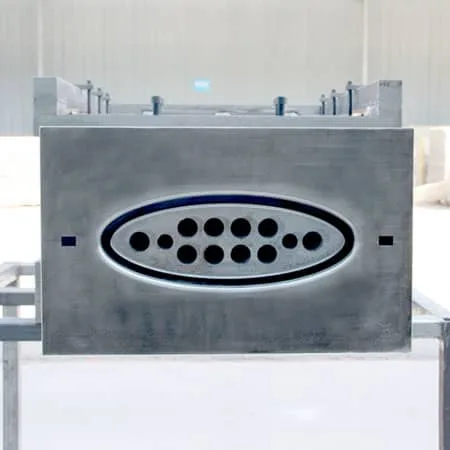
- Oval tube 280 × 100 mm
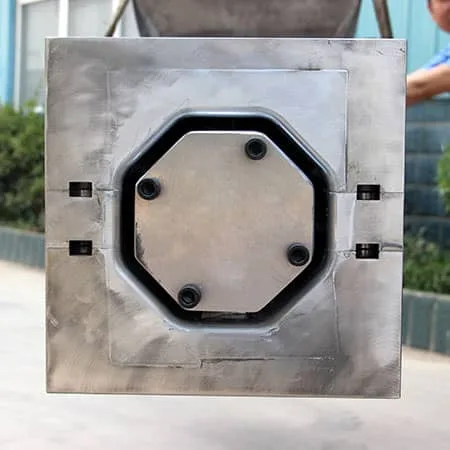
- Octagonal tube φ153 × 10 mm
- Concave and fluted tubes
- Round, square, hexagonal and oval rods
- Six-cavity round rod die
Process
From drawing to die
What you supply and what you receive at each step.
- 01
Cross-section review
Buyer + die engineer
You send the drawing, resin system and target speed. The team checks wall thickness, radii and corners for pultrudability.
- 02
DFM feedback
Die engineer
Written feedback on changes that improve cure, fiber placement and die life, with the proposed fiber layout.
- 03
3D model approval
Buyer approval
Die plates, mandrel, heating layout and guide plates are modeled. Steel is cut only after you approve.
- 04
Machining and chrome
Die shop
Gantry milling, CNC, EDM and wire-cut, heat treatment, polishing and hard chrome plating.
- 05
Trial pull and report
Factory QC
The die runs on the factory's own line. You receive samples and a dimensional report before shipment.
From the workshop
Photographs
Commercial terms
Who you contract with
- Manufacturer and warranty party
- Henan Zhongsheng Composite Material Co., Ltd.
- Contracting party and exporter of record
- Pultruded Export, Shanghai, China
- Incoterms
- FOB Chinese port by default; CIF/DAP on request
- Payment
- Milestones tied to drawing approval, FAT acceptance and shipment. Exact split on the quotation.
- Third-party inspection
- SGS, BV or TÜV pre-shipment inspection accepted, cost borne by the buyer
- Electrical
- 380 V 50 Hz standard; 480 V 60 Hz and other supplies on request. CE-oriented panel standard; UL 508A option quoted separately.
FAQ
Questions buyers ask
- How is the mandrel supported?
- The mandrel is cantilevered from a bridge upstream of the die entry. Its length, taper and fixing are part of the die design and appear on the 3D model you approve.
- How many cavities can a rod die have?
- Cavity count is limited by puller width, clamping force and how evenly heat reaches each cavity. The factory has built six-cavity round rod dies; the right count for your rod is set during DFM.
- Can you build a die for my existing machine?
- Yes. Send the die table dimensions, heating-plate layout and clamping method of your machine with the profile drawing.
- What tolerance can a thin-walled tube hold?
- Wall-thickness variation depends on mandrel deflection and fiber balance more than on cavity accuracy. The achievable tolerance is stated for your section after DFM.
Next step
Send a cross-section drawing. Get a DFM review and a scoped quotation.
Quotations state the manufacturer, the exporter of record, the warranty party, FAT scope and payment milestones. No figure is quoted without a drawing.